

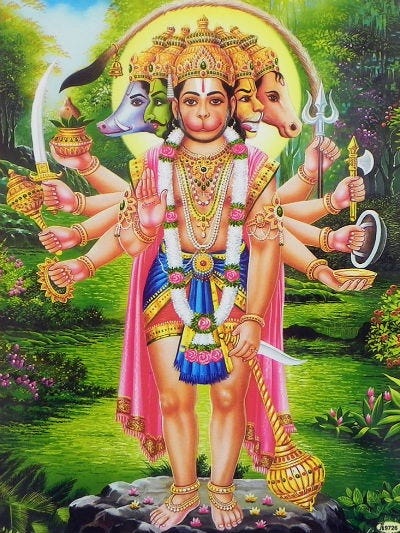
Panchamukha Hanuman, is a representation of him, showing 5 faces, in different directions. It is based on the incident in Ramayana, where Hanuman assumes the form to kill, Ahiravana, the king of Pathala, and Ravan’s brother.
During the battle with Rama, as Ravana’s fortunes waned and his mighty son Indrajit fell, desperation drove him to summon Ahiravana, the sorcerer-king of the underworld. Ahiravana, cunning and ruthless, vowed to turn the tide by capturing Rama and Lakshmana alive, offering them as sacrifice to Goddess Mahamaya.
Vibhishana, ever watchful, sensed the danger and warned Hanuman. “Guard them well,” he urged, “for Ahiravana is a master of disguise. Trust no form, no face.” Hanuman, steadfast in his devotion, stood sentinel at the brothers’ resting place, thwarting every attempt of the demon who came cloaked in deception.
But Ahiravana’s trickery was relentless. At last, he assumed the guise of Vibhishana himself. Hanuman, momentarily deceived by the familiar form, allowed him entry. In that instant, the sorcerer seized Rama and Lakshmana, spiriting them away into the depths of Pataal Lok.
Thus began the fateful descent , a clash not only of strength but of cunning, where Hanuman’s devotion would be tested against the shadows of illusion. It was here, in the underworld, that the mighty Panchamukhi form would emerge, a divine answer to Ahiravana’s dark sorcery.
When Hanuman realized he had been deceived, his heart burned with resolve. He vowed to Vibhishana that he would descend into the netherworld, rescue Rama and Lakshmana, and destroy Ahiravana. With unshakable devotion, he plunged into Pātāla Loka, where the sorcerer’s palace rose vast and forbidding, guarded on all sides.
At the gates stood Makardhwaja, a strange guardian , half vanara, half fish , born of Hanuman’s own essence when a drop of his sweat had fallen into the ocean and been swallowed by a makara. Though bound by duty, Makardhwaja was, in a way, Hanuman’s son. Father and son clashed, and though Hanuman overcame him, he spared his life, recognizing the bond of destiny between them.
Pressing forward, Hanuman entered Ahiravana’s labyrinthine palace. There he learned the secret, the demon’s life was tied to five lamps burning in five different directions. To extinguish them all at once was impossible for any ordinary being. But Hanuman was no ordinary guardian.
Summoning divine power, he manifested as Panchamukha Anjaneya , five faces radiating in five directions, each embodying a different deity’s strength.
Anjaneya (East) — bestower of Ishta Siddhi, fulfillment of cherished desires.
Karala Ugraveera Narasimha (South) — granter of Abhishta Siddhi, protection and victory over evil.
Mahaveera Garuda (West) — source of Sakala Saubhagya, prosperity and auspiciousness.
Lakshmi Varaha (North) — giver of Dhana Prapthi, wealth and upliftment.
Hayagriva (Upwards) — master of Sarva Vidya Jaya Prapthi, wisdom and triumph in knowledge.
With this fivefold manifestation, Hanuman extinguished the lamps in a single moment, breaking Ahiravana’s power. Armed with ten weapons, he struck down the sorcerer, shattering the darkness of illusion and restoring Rama and Lakshmana to freedom.
The five faces are said to represent Hanuman’s control over the five senses , sight, sound, touch, taste, and smell. Just as he extinguished the five lamps burning in different directions, he symbolizes the extinguishing of distractions and illusions that arise from the senses. In this way, Panchamukhi Hanuman becomes a reminder that true strength lies in discipline, awareness, and mastery of the self.
A very beautiful couplet in Kamba Ramayanam, explains the significance here.
The son of one of the five elements( Vayu or wind) , crossed one of the five elements( Sagara or Ocean, Water), through another of the elements( Sky), and met the daughter of another element( Sita, being the daughter of Earth). And then burnt down Lanka by Fire( another element).
It is said that Hanuman appeared in his Panchamukhi form to Shri Raghavendra Swamy, the great saint of Mantralayam, during his penance. At that very spot, the Panchamukhi Anjaneyaswamy Temple was established, sanctifying the place as a site of divine vision and spiritual power. Devotees believe that Hanuman’s five-faced manifestation here was not only a reminder of his victory over Ahiravana, but also a blessing to Raghavendra Swamy , affirming protection, wisdom, and mastery over the senses.
There are 5 forms of prayer to him, aligning with the five faces of Panchamukhi Hanuman.
Naman (Salutation) → Anjaneya (East) — bowing in reverence, seeking fulfillment of desires (Ishta Siddhi).
Smaran (Remembrance) → Narasimha (South) — constant remembrance of the divine, granting protection and victory (Abhishta Siddhi).
Keerthanam (Chanting/Glorification) → Garuda (West) — singing praises that dispel obstacles and bring prosperity (Sakala Saubhagya).
Yachanam (Supplication/Prayer) → Varaha (North) — heartfelt petitions for upliftment and wealth (Dhana Prapthi).
Arpanam (Offering/Surrender) → Hayagriva (Upwards) — surrendering the self, attaining wisdom and mastery (Sarva Vidya Jaya Prapthi).
Panchamukhi Hanuman form is often seen as embodying not just power, but the very essence of devotion described in the Bhagavad Gita.
“He who acts for me, who is engrossed in me, who is my devotee, who is free from attachment — he reaches me.”
Anjaneya (East) → He who acts for me — symbolizing service and action dedicated to the divine.
Narasimha (South) → He who is engrossed in me — fierce concentration and unwavering focus on dharma.
Garuda (West) → He who is my devotee — devotion expressed through protection and upliftment.
Varaha (North) → He who is free from attachment — strength to rise above material bonds, granting wealth without clinging.
Hayagriva (Upwards) → He reaches me — wisdom and knowledge leading to union with the divine.
Thus, Panchamukhi Hanuman is not only a warrior who defeated Ahiravana, but also a living embodiment of Krishna’s teaching , showing that devotion, discipline, and detachment together lead to liberation. His five faces are a reminder that the path to God is fivefold: action, absorption, devotion, detachment, and realization